
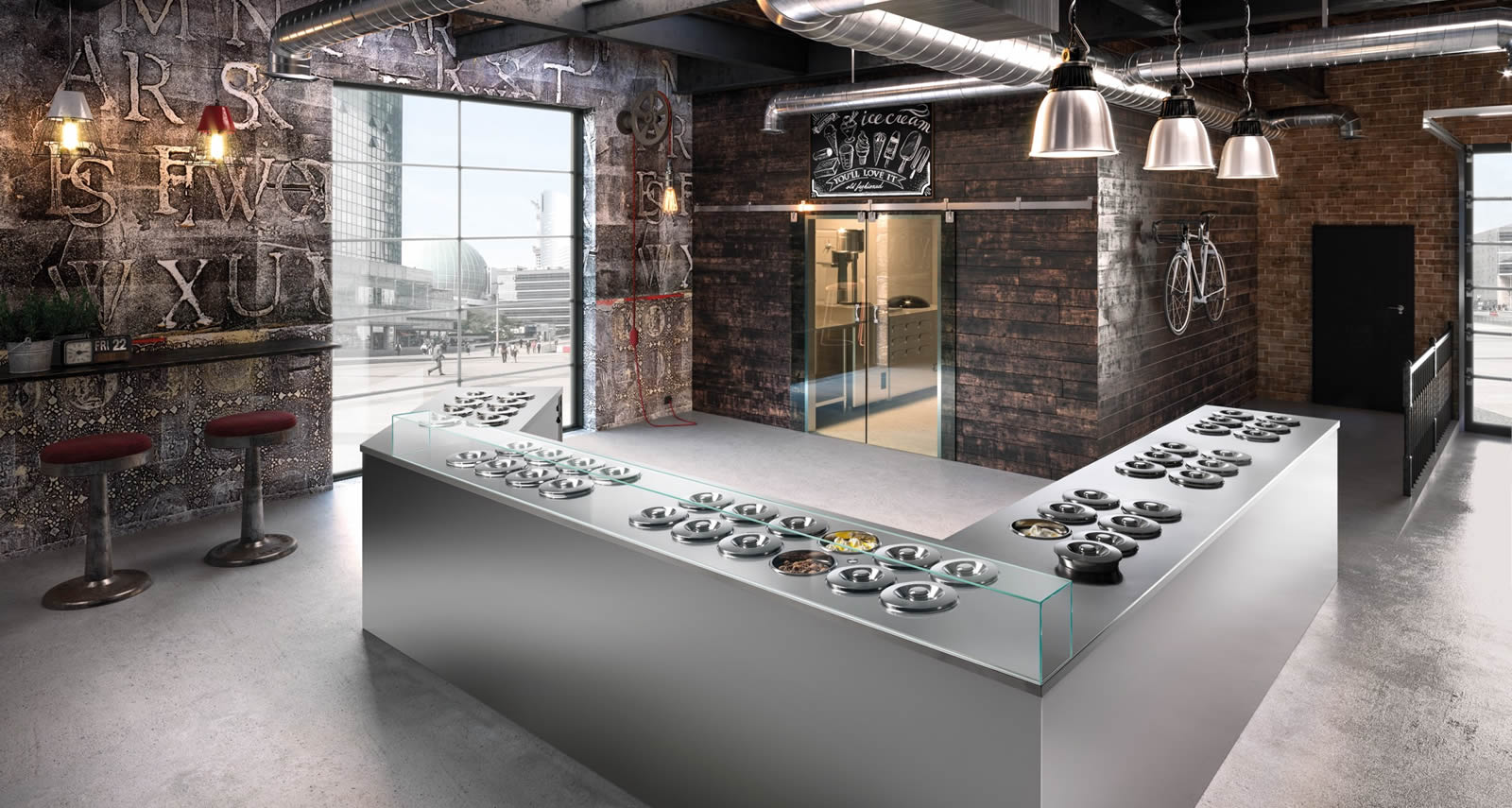

Pozzetti ice-cream modules come with two systems for storage in covered tubs: glycol, the most traditional, recommended for continuous use, and forced-air, ready in about 30 to 40 minutes and suited to discontinuous use. AISI 304 stainless steel tanks with 70 mm of insulation, anti-rotation tubs and an integral or remote motor: the modules fit into counters or build in, working from -6 to -18 °C for ice cream or slush.


Pozzetti Ice Cream features
WEIGHT AND INSTALLATION
Glycol modules are much heavier than the forced-air equivalent due to the amount of liquid they contain, and the tank also has to be filled with the glycol and water mixture on first installation, while the forced-air type is ready for use.
TEMPERATURE DIFFERENCE
Both systems guarantee a minimal difference between the upper tub and the spare tub stored underneath.
ENERGY SAVING
Both glycol and forced-air pozzetti modules have tanks insulated with 70 mm of expanded polyurethane with a density of 40 kg/m³, guaranteeing lower heat loss than the thinner constructions normally found on the market, and thus saving energy.
CONSUMPTION AND OPERATING TIMES
Since glycol pozzetti modules have to refrigerate a considerable amount of liquid, they take about 10/12 hours to reach the operating temperature, after which the temperature is maintained with very little energy, and in the event of a power blackout the ice-cream will be conserved for many hours due to the thermal inertia of the liquid mass.
Usually, a glycol module is switched on at the start of the season and not switched off again until the end, because it is recommended for continuous use. A pozzetti module with forced-air refrigeration requires very little time (about 30/40 minutes) and electricity to reach the operating temperature initially, but in order to keep the temperature constant it requires more frequent motor operation, and the ice-cream will be conserved for less time than in the glycol type in the event of a power blackout. Forced-air modules are recommended for discontinuous use, or for businesses operating on alternating days, or only at certain times of day.
USE AND PRODUCT
Pozzetti ice-cream modules with both glycol and forced-air refrigeration can be used at negative temperatures (from -6°C to -18°C) for ice-cream or slushes.
FAQ
What dimensions and versions do the Pozzetti ice-cream modules come in?
Pozzetti ice-cream modules with two rows are 650 mm deep, in lengths from 400 to 1650 mm for 2, 4, 6, 8, 10 or 12 wells. Glycol modules also come with a single row, 400 mm deep, from 650 to 1650 mm for 2, 3, 5 or 6 wells.
Which refrigeration systems do they use?
Pozzetti modules use glycol, with antifreeze liquid, a copper coil on the walls and natural convection, or forced air, with a coil on the walls and fans at the tank centre. Both are valve systems, with minimal temperature difference between the upper and the spare tub, and work in climate class 3 (25 °C, 60% relative humidity).
Which materials and finishes are they made with?
Pozzetti ice-cream modules have a tank in AISI 304 stainless steel, insulated with 70 mm of expanded polyurethane with a density of 40 kg/m³, and a one-piece copper coil without joints. The back panel and side walls are in coated sheet metal. Lids, stainless steel collar and top are standard; the optional tubs have an anti-rotation system.
How are they installed and supplied?
Pozzetti ice-cream modules are supplied installed in counters or built-in, with integral or remote motor. The base is a metal frame with adjustable feet and a footboard profile; with a remote motor the motor compartment is open. The glycol must be mixed with 50% distilled water; if supplied by the company it comes pre-mixed in 20 litre cans.
How do controls, draining and cool-down work?
Pozzetti ice-cream modules have a control panel with digital thermostat and master switch. The tank has a drain with threaded cap; the glycol tank also has a safety overflow pipe. On forced-air modules the fans can be inspected and removed. A glycol module reaches operating temperature in about 10/12 hours, a forced-air module in about 30/40 minutes.
What changes between the glycol and the forced-air version?
Pozzetti ice-cream modules with glycol come with or without a double-depth tank, with one or two rows; forced-air modules come only with two rows and a double-depth tank. The glycol and water mixture goes into the tank at first installation, while the forced-air module is ready to use; on request motors are tropicalised or with water or mixed condensation.